












(Re)in Summary
• Dhipaya Insurance leads the Construction All Risks (CAR) policy for the crane collapse on a Bangkok–Ubon express train.
• Dhipaya underwrote 60% of the risk, with Bangkok Insurance and Intra Insurance covering 20% each.
• The accident, which occurred on 14 January, led to the deaths of at least 32, with 67 injured.
• The CAR policy, held by contractor Italian-Thai Development, provides third-party liability coverage of 583m baht (US$18.5m).
• The crane collapse is one of several recent fatal construction accidents involving ITD over the last 12 months, including a second fatal collapse just 24 hours later.
Thailand’s Office of the Insurance Commission (OIC) has named Dhipaya Insurance as the lead carrier for the Contractor All Risks (CAR) policy tied to the crane that collapsed and struck a Bangkok–Ubon express train in Thailand, on 14 January.
Italian-Thai Development (ITD) was the construction contractor for the rail segment and has a CAR policy with third-party liability coverage of 583m baht (approx. US$18.5m). Dhipaya underwrote 60% of the risk, with Bangkok Insurance and Intra Insurance covering 20% each.
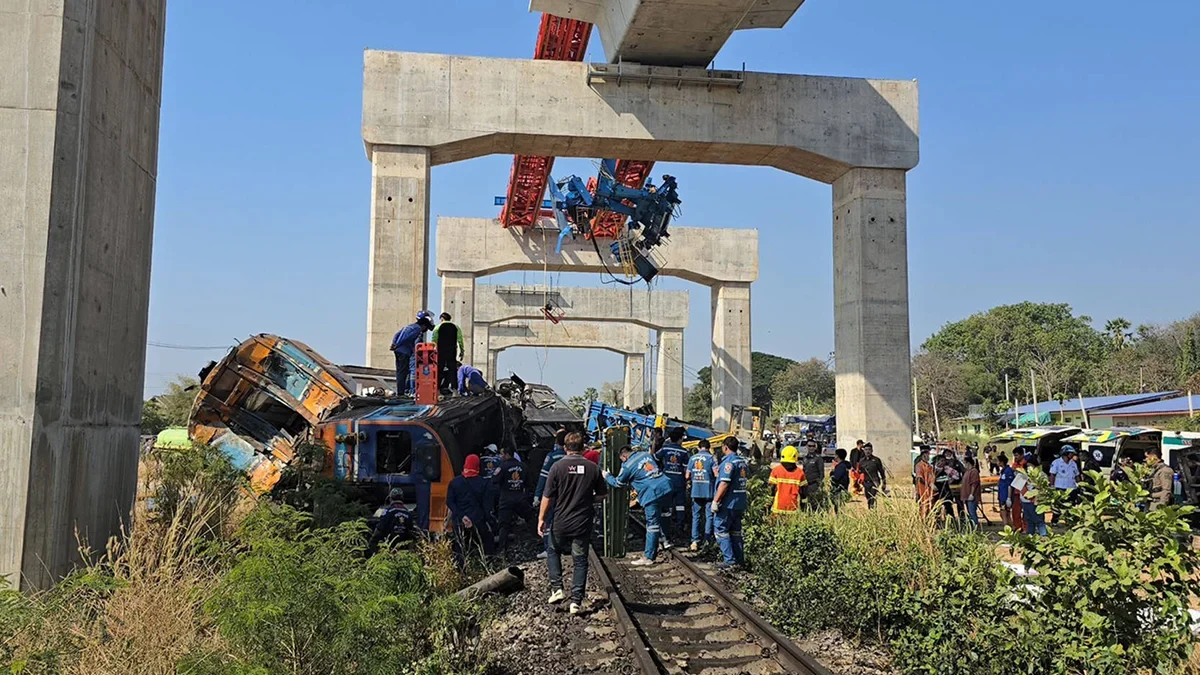
The incident occurred at around 9:30 am local time when a crane used for high-speed rail construction fell onto Special Express train No. 21 near railway kilometre 220 near Sikhio District, Nakhon Ratchasima. The impact derailed one carriage and ignited a fire in another, killing at least 32 people and injuring 67 others.
In response, the OIC has mobilised its catastrophe response protocol and is pressing the consortium to process claims promptly and accurately while state investigators examine the cause and liability. The regulator says it has also brokered direct-settlement agreements between all three construction insurers and local hospitals to shield injured claimants from upfront medical costs during the acute treatment phase.
Dhipaya Insurance will pay an initial compensation of 1,000,000 baht to each fatality and will consider additional remedies, ‘according to the principles of fairness,’ according to the OIC.”
The State Railway of Thailand has also approved interim relief of 80,000 baht per fatality: 40,000 baht for funeral expenses, and 40,000 baht as an advance on final settlement. However, Thailand’s Prime Minister Anutin Charnvirakul blasted the amount as insufficient. “That’s not enough,” he said. “It should be in the millions. This is not just a slap in the face to the victims’ families, but a slap in the face to the government, as well.”
The Sikhio collapse was followed within 24 hours by a second fatal crane accident on Rama II Road near Bangkok, a project which also involved ITD, prompting a safety audit of all the firm’s projects.
The incidents are the latest in a series of fatal construction accidents involving the ITD over the past year.
On 28 March 2025, a 7.7-magnitude quake struck central Myanmar but shook Thailand and caused the collapse of a partially built 30-storey building in Bangkok, killing 92 people. Barely two weeks prior, on 15 March 2025, at least five people were killed and 27 injured after a then under-construction bridge on the Rama III–Dao Khanong Expressway Project collapsed in Bangkok.