Emerging risks | Growth Opportunities | APAC Insurance

Tuesday, July 14, 2026

Feature Interview

Mainland Chinese turn away from Hong Kong health insurance post-Covid

Swiss Re’s Head of Hong Kong and Taiwan says that sales of life insurance and savings products are still booming.
November 1, 2024

 • 

6 min read

(Re)in Summary

• Swiss Re’s Head of Hong Kong and Taiwan, Toben Swart, says that Mainland Chinese customers are a critical segment for a number of business lines in the SAR.
• Chinese customers are attracted to Hong Kong’s dollar peg and the relatively sophisticated insurance products on sale.
• New life insurance sales in the first half of 2024 hit a record HKD115.9bn, up from HKD$103bn 12 months earlier, but medical numbers have not seen a similar rebound.
• A dramatic improvement in Chinese healthcare facilities, partly driven by Covid itself, means medical reimbursement product sales are unlikely to recover.

The reopening of Hong Kong’s borders to Mainland China visitors at the start of 2023 was touted by consultants as a golden opportunity for insurers. Oliver Wyman predicted a sales boom for investment products appetite for which had been hemmed in by pandemic travel restrictions.

A survey it conducted at the start of 2023 reported that 72% of respondents said they intended to travel to the city and buy life insurance products over the next two years.

This optimism was not misplaced. The Hong Kong Insurance Authority reported that new life insurance sales in the first half of 2024 reached a record of  HKD115.9bn (US$14.9 bn), up from HKD$103bn for the same period 12 months earlier – which in itself was a record.

Torben Swart, Head of Life & Health in Hong Kong and Taiwan for Swiss Re, says these numbers underlie the importance of Mainland Chinese customers to Hong Kong insurers.

“When you look at the Hong Kong market, the main lines of business are: savings, whole of life, or very long term endowment, critical illness, and medical reimbursement. In all of these lines, mainland Chinese visitors are a very relevant customer segment for local companies,” he says.

While both life and health products sold in Hong Kong are attractive to mainland consumers the drivers for buying each segment are different.

Yielding results

Not only are US dollar products unavailable onshore in China, the ongoing interest rate differential between the greenback and the yuan provides a yield incentive that makes Hong Kong savings products attractive beyond portfolio diversification.

For critical illness, and medical reimbursement products, the explanation is simply the high quality of Hong Kong’s healthcare systems. According to the US think tank FREOPP the SAR ranked behind only Singapore in Asia in terms of healthcare innovation (the cities were 12th and 10th respectively on the global list).

China’s healthcare system wasn’t even one of the 32 countries surveyed by FFEOPP.

“Hong Kong insurance products are attractive to mainland Chinese buyers because they offer interesting investment opportunities, and more complex and sophisticated product designs. And on medical reimbursement, it gives access to the very advanced Hong Kong healthcare system,” says Swart.

But not only is premium volume now higher than pre-Covid, the structure of this business has shifted.”
avatar

Torben Swart

Head of Life & Health, Hong Kong and Taiwan at Swiss Re

Swart says that Covid changed this dynamic and while the sale of insurance products to Mainland Chinese customers rebounded quickly in 2023, particularly in comparison to 2019 where numbers were dampened by the Hong Kong protest movement, this only applies to investment products and not the medical segment.

“In the first half of 2024, single premium business was HKD49bn, versus HKD26bn for the same period in 2019 – that’s a massive rebound.

But not only is premium volume now higher than pre-Covid, the structure of this business has shifted. It’s much more savings dominated and the protection lines of critical illness and health insurance have not reached the level that they had pre-Covid,” says Swart.

Healthy targets

The Head of Life and Health cites a number of factors for this change, starting with incentives – savings products offer the easiest route to commission for agents, particularly in an environment of pent-up consumer demand.

And interest rates in Hong Kong still offer a healthy spread over RMB denominated products, even after the recent US Federal Reserve 50 bps rate cut.

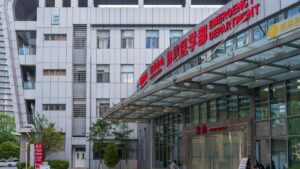
The other is an improvement in China’s healthcare system, partially driven by Covid but also government policy.

In October 2016, Chinese leaders announced the launch of the Healthy China 2030 initiative, intended to improve healthcare outcomes via a variety of means including: promoting healthy lifestyles, improving health protection, building a healthy environment and developing the health industry.

The initiative’s slogan may be; ‘Health for all, all for health’, but private sector healthcare facilities appear to have received a particular boost in the intervening years. According to research by the Lancet published in March 2024, private hospitals now outnumber public facilities by a factor of two.

Added to this is the economic development that has occurred in China. According to Statista, GDP per capita in Shenzhen has increased from RMB124,000 ($17,400) in 2013 to nearly RMB200,000 ten years later.

China’s healthcare system also received – a perhaps unwelcome – boost from the pandemic.

“Shenzhen and other big cities have developed a lot in the last decades. The China of the early 2000s is not like the China of today. That is just a natural evolution, but Covid certainly accelerated the development,” says Swart.

No return

One obvious impact of Covid in China is the change in the approach to lung screening. According to the Journal of Thoracic Oncology, lung cancer is the leading cause of cancer-related mortality in China, accounting for nearly 19.2% of all deaths.

There was a significant increase in lung screening demand in China during the pandemic, due to the overlapping symptoms of Covid and lung cancer, supported by a significant level of state investment.

“When we look at medical infrastructure, there was a huge investment in screening technology. For example, there was a big increase in the number of low dosage CT machines used for lung screenings, which leads to earlier detection of lung cancer now,” says Swart.

The Mainland China health insurance market isn’t the same as it was pre-Covid. When you look at the medical system, there has been a very significant development of the infrastructure in China.”

Torben Swart

Head of Life & Health, Hong Kong and Taiwan at Swiss Re

Despite this myriad of healthcare policy changes, Swart says the driving factor behind improving medical facilities in China is its extended period of economic growth and corresponding higher levels of infrastructure and tech.

Whatever the explanation it appears that Mainland Chinese citizens’ appetite for Hong Kong health insurance has changed for good.

“The Mainland China health insurance market isn’t the same as it was pre-Covid. When you look at the medical system, there has been a very significant development of the infrastructure in China. In Hong Kong, hospitals are still leading at least the region, if not the world.

But for many treatments, where only five years ago you had to go to Hong Kong to get quality care, you can get the same level of care in Shenzhen, and of course, treatment cost is lower there, so there’s also been a structural shift of demand on the mainland,” says Swart.