



(Re)in Summary
• The insurance-linked securities (ILS) market is shifting into a more mature phase, supported by record issuance, stable returns and expanding institutional demand.
• Asia is seen as a key growth frontier due to rising catastrophe exposure, widening protection gaps and growing pools of capital.
• Persistent constraints, including limited data quality, uneven transparency, investor education gaps and regulatory trust, continue to slow regional adoption.
• Market participants expect gradual but sustained expansion, with ratings frameworks and regulatory credibility likely to determine how quickly Asia captures a larger share of global issuance.
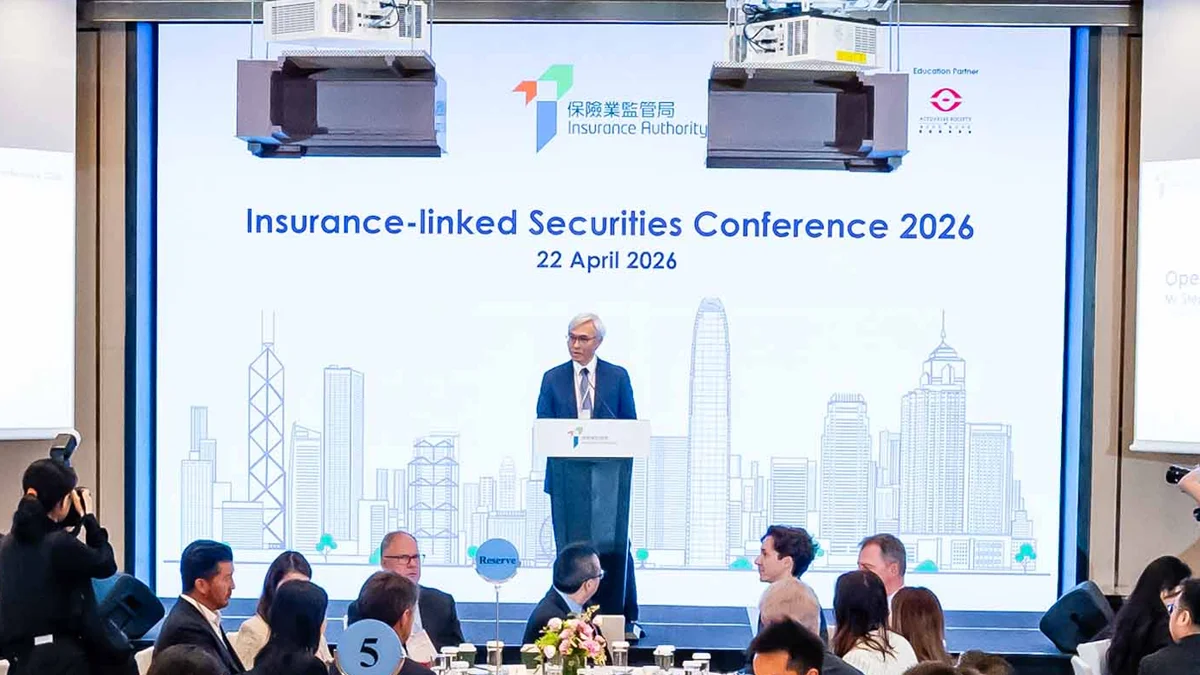
The insurance-linked securities (ILS) market is entering a more mature phase, supported by record issuance, stable returns and expanding institutional demand, with Asia increasingly positioned to play a larger role in the next stage of growth, panellists said at the ILS Conference 2026 in Hong Kong.
Panellists consistently identified Asia as one of the most important frontiers for the next wave of ILS development, citing rising catastrophe exposure, large protection gaps, and growing pools of regional capital.
In his opening remarks, Stephen Yiu, Chairman of the IA, said alternative investments are “gaining more attention than ever from institutional investors looking for balanced risk-adjusted return amidst rising uncertainties, as borne out by the massive flow of capital into ILS products.” “Gifted with an open and sophisticated financial market, unique connectivity with the Chinese Mainland and the patronage of some 3,380 family offices, Hong Kong is ideally placed to promote the usage of alternative risk transfer tools,” he added.
“Asia has an incredible opportunity,” said Mr Stefan Kräuchi, Partner and CEO at HSZ (Hong Kong) Limited. “We have increasing capacity risk, we have the protection gap, but at the same time, we have a growing pool of capital here.”
In many developing Asian markets, uninsured losses still account for a large share of disaster damage. Swiss Re estimates Asia’s flood protection gap at about 83%, underscoring sustained demand for additional risk-transfer capacity beyond traditional reinsurance.
At the same time, institutional investors are increasingly seeking assets that offer diversification from traditional financial markets. ILS has gained attention because returns are largely driven by catastrophe events rather than macroeconomic cycles.
Issuance has remained robust in recent years, with catastrophe bonds emerging as the most standardised and liquid segment of the ILS market.
Even as reinsurance pricing has softened following several years of hard market conditions, sponsors have continued to issue cat bonds to secure capacity and reduce exposure to market volatility.
“[ILS] isn’t subject to the cycle that we see, which is a good thing when we consider the pricing,” said Victor Kuk, Chief Executive Officer at Peak Re, who officially started his new role at the Hong Kong-headquartered reinsurer this week.
Innovation in trigger design is also reshaping the cat bond landscape, particularly in Asia, where risk profiles and data availability vary widely across markets.
While indemnity triggers remain common in developed markets with strong claims data, parametric and hybrid structures are gaining traction in regions where limited data makes loss estimation more complex.
One prime example is Peak Re’s Black Kite II, announced in April 2025. The US$50m catastrophe bond mixes industry-loss triggers for Japanese earthquake and typhoon risks with parametric triggers for earthquakes in China and India.
Structural gaps still constrain growth
But despite favourable market conditions, persistent structural constraints continue to slow the pace of ILS adoption in Asia.
Foremost among them is the quality and availability of risk data. While catastrophe modelling has improved significantly in recent years, data coverage remains uneven across countries, particularly in emerging markets where historical loss records and exposure databases are still developing.
Transparency and standardisation were also identified as critical issues, especially as the investor base expands beyond specialist funds into mainstream asset managers and pension institutions.
“From an investor perspective, they love neat, clean, easy to understand risk, which then ties back to the data,” said Cate Cocks née Kenworthy, Managing Director and Head of Investor Development at Howden Capital Markets & Advisory.
Ratings, regulatory credibility seen as key catalysts
As the investor base broadens, credit ratings and more standardised structures become more important to the cat bond market’s next phase of growth.
Many institutional investors operate under mandates that require rated securities, making the re-entry of agencies such as Moody’s into the ILS market a potentially important catalyst for broader participation. Greater standardisation in documentation and trigger mechanisms could also improve market efficiency and liquidity.
Speakers also highlighted the role of regulatory credibility and consistency in building market confidence. In February, Hong Kong reinforced its ambitions to become a regional risk transfer and speciality insurance hub, extending its ILS incentive scheme to 2028 in Financial Secretary Paul Chan’s 2026–27 budget speech. The Insurance Authority said it would intensify global promotion efforts to attract further catastrophe bond and ILS issuance.
Singapore also introduced its ILS grant scheme in 2019 to subsidise issuance costs and has since extended the programme several times, with the latest phase running from January 2026 to December 2028.
The market’s recent cat bond activity has been concentrated among a small group of repeat Singapore-domiciled programmes, including Kizuna Re, Tomoni Re, Nakama Re and Phoenix Re.
Gradual expansion expected
Despite the remaining challenges, the overall outlook was cautiously optimistic. Global cat bond and related ILS issuance reached a record US$25.6bn in 2025, lifting outstanding market value above US$60bn.
Asia’s share of global issuance is likewise expected to rise steadily as regulatory frameworks mature, data quality improves, and investor familiarity deepens. If those elements fall into place, Asia could move from being a promising growth story to becoming a central pillar of the global ILS market.
“As Asia’s regulatory framework becomes more mature and gains more trust, this would play an important role in boosting the ILS market,” said Chen Huang, Associate Managing Director of Financial Institutions at Moody’s Ratings.

![[explicit brand] logo.](https://reinasia.com/wp-content/uploads/2026/09/china-insurer-capital-injections-strengthen-resilience-but-capital-pressures-remain-s-p-fitch-300x169.jpg "China insurer capital injections strengthen resilience but capital pressures remain")