

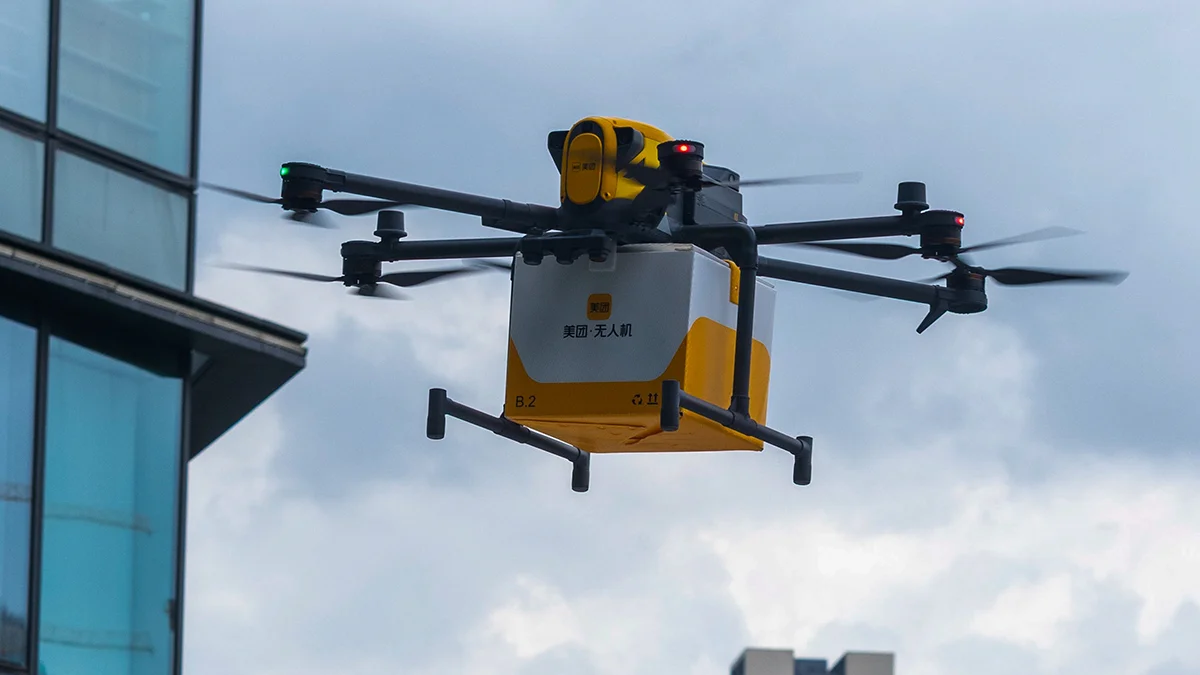
China’s skies are getting busier. Drones deliver parcels, rush blood samples to hospitals and scout for survivors at sea. All these activities introduce new and complex risks and a growing need for insurance coverage across the low-altitude economy (LAE).
The worldwide market for LAE insurance is still nascent at US$7.5m in 2024, according to data from Intelmarket Research, but is forecast to reach US$521m by 2032, with carriers including AIG, Allianz, Chubb and Hiscox building out drone insurance lines in North America and Europe.
But no country has scaled its low-altitude economy faster than China, and how local insurers manage the risks there will likely set a template for carriers around the world.
China’s low-altitude airspace economy (LAE), broadly defined as activity in airspace up to 3,000 metres above ground, is moving into scale, spanning drones, helicopters, fixed-wing aircraft, and electric vertical take-off and landing (eVTOL) platforms.
In healthcare, medical delivery drones were already being standardised in hospitals in several cities, improving transport times for blood samples daily. China has also expanded its emergency deployments, including drones for on-site life support functions and maritime search-and-rescue. Fire trucks have mounted drone systems for large or hard-to-reach blazes, with drills already underway.
Its agricultural rollout is also considerable. In 2024, agricultural drones covered more than 173 million hectares of farmland, supporting over 500,000 jobs across spraying, sowing, fertilisation and crop monitoring. In the logistics sector, Ministry of Transport data shows drones delivered about 2.7 million parcels nationwide that same year, across short-haul, cross-region and in-city routes.
China now counts 969 enterprises, 3,191 low-altitude products and more than 4.78 million registered units, as of November last year. Longer-term projections point to a market of ¥3.5t (US$507bn) by 2035.
Momentum is also spreading in other areas of Asia-Pacific. Korea’s urban air mobility (UAM) industry is gathering pace, with groups such as POSCO and Hyundai developing vertiports, airports for vertical take-off and landing of small aircraft, for emergency transport and commuting.
Japan is aiming for commercial air-taxi operations this year, with Kansai routes and Osaka Bay demo flights that operators say could cut travel times by up to 80%.
In Southeast Asia, Malaysian drone operators are eyeing expansion into agriculture-heavy Indonesia and the Philippines, and into Vietnam, where the government has signalled interest in drones for smart farming and digital acceleration.
But no country comes close to China in the scale of its LAE economy, which the Civil Aviation Administration of China values at ¥670bn (US$93bn) in 2024, on a trajectory to ¥3.5t (US$507bn) by 2035. And its insurance market is racing to ensure it keeps up.

Hequn Shi
Director of Group Business at Ping An Property & Casualty InsuranceInsurers follow the boom
The last public tally identified 45 low-altitude-economy-related insurance products in China as of July 2024. Since then, Ping An P&C says the market now has 87 such products, indicating a near doubling of available cover.
“According to regulatory statistics, there are currently 87 products related to the low-altitude economy available in the market,” says Hequn Shi, Director of Group Business at Ping An Property & Casualty Insurance.
“As the volume of low-altitude economic activities grows and industry maturity increases, the insurance base expands, and the premium scale continues to maintain double-digit growth.”
Ping An says core products remain aircraft hull/property, third-party liability, passenger or personal accident, and product liability, though insurers are increasingly adding extensions around cyber and data security.
In terms of product design, insurers are moving from stand-alone policies to bundled, use-case-specific solutions to address gaps and risks in parcel delivery, passenger transport and urban governance.

Laurel Hu
Head of Casualty Underwriting APAC at Swiss RePrevious data points to stronger participation among larger insurers, a pattern likely to persist into 2026. In July 2024, more than 75% of insurers with annual premiums above ¥30bn had launched low-altitude-economy-related products, compared with significantly lower take-up among carriers with premiums below ¥2bn.
“These numbers are likely to continue on an uptrend beyond 2025,” said Laurel Hu, Head of Casualty Underwriting APAC at Swiss Re.
Underwriting strain amid softening
Ping An identifies three areas that remain especially difficult to underwrite: flight safety risk, data and information security risk, and low-altitude infrastructure risk. High-frequency operations over densely populated areas can still produce low-probability, high-severity events, particularly where third-party injury and public safety are involved.
That challenge is compounded by how different drones and eVTOLs are from traditional general aviation aircraft. Their risk is shaped less by airframe type alone and more by use cases, terrain, flight routes and technology design.
Capacity, while broad overall, is still selective for high-value drones where advanced technology and concentrated asset values raise loss potential.
“At present, in the vast majority of scenarios, the insurance market’s underwriting capacity is very sufficient,” Shi says. “However, for some high-value large drones—which combine both high value and high technological risk—the market’s underwriting capacity still has room for enhancement.”
Competition is also pushing rates down. Premiums have trended lower over the past two years as more insurers enter the segment. “A large number of insurance companies are paying attention to and entering the low-altitude economy arena, leading to a downward trend in premium rates over the past two years,” Shi notes.
Hequn Shi
Director of Group Business at Ping An Property & Casualty InsuranceChina’s revised Civil Aviation Law, due to take effect in July 2026, is expected to be a key factor in reshaping liability structures and underwriting expectations. The revised law is expected to provide clearer delineation of liability for third-party injury, property damage and public infrastructure losses, which could increase claims severity and raise capital requirements over time.
The reforms could also provide national-level legal certainty. Insurers expect tighter data integration, flight monitoring and airworthiness standards to support more dynamic, behaviour-based underwriting.
“Insurance may become a fundamental element of the low-altitude operation system,” Shi notes.
Hong Kong steps up readiness
Global markets will be watching how LAE and insurance coverage develop on the Mainland. And in Hong Kong, LAE activity is also beginning to take shape.
The Insurance Authority (IA) says more than 13 insurers now offer relevant cover, with minimum liability thresholds already written into Hong Kong’s framework for small unmanned aircraft (SUA) operators.
“Under the present law, operations of small unmanned aircraft (SUA) are required to be covered by third-party bodily injury or death liability insurance with a minimum sum assured ranging from $10 million to $20 million, depending on their weight and operational risk level,” said MM Lee, Executive Director of General Business at the IA in remarks shared in February.
To refine pricing and underwriting, the IA is urging insurers to use data from the government’s Regulatory Sandbox, a trial programme for low-altitude flight use cases, and the upgraded Regulatory Sandbox X.
The Hong Kong Federation of Insurers (HKFI) is also reviewing complex and cross-border underwriting challenges through a dedicated LAE task force.
Those advances come as the policy roadmap in Hong Kong is also beginning to firm up. In his 2026–27 Budget speech on 25 Feb, Financial Secretary Paul Chan positioned LAE as a “new engine for smart-city development and regional integration.”
Chan says that 32 Regulatory Sandbox trials had already been conducted along designated routes.
He also said that the government had “completed the first‑stage legislative amendment exercise” and “will refine the legislation and regulatory framework on civil aviation” to lay the foundation for a long-term, competitive LAE ecosystem.
MM Lee
Executive Director of General Business at the Hong Kong Insurance AuthorityMore complex projects, including unmanned aircraft traffic management systems, shared platforms, cross-boundary routes and passenger-carrying aircraft, are slated to roll out in phases from the first half of the year, alongside exploration of cross-boundary low-altitude logistics with the Mainland.
“As applications within low-altitude economy become increasingly diversified – including the operation of larger and higher-payload unmanned aircraft, drone-enabled logistics, emergency response, medical supply transportation and manned low-altitude transports in the future – the relevant risk landscape will inevitably become more complex,” the IA’s Lee says.
“We believe that the insurance industry can play a more significant role through product innovation, cross-border collaboration and talent development, contributing to the establishment of a safe and cost-effective risk management framework, thereby supporting the sustainable development of low-altitude economy,” says Lee.