












(Re)in Summary
• Manulife’s retail underwriters are being reskilled through a career conversion programme to leverage AI for enhanced risk analysis and decision-making.
• The insurer’s Singapore AI Centre of Excellence will focus on making insurance simpler and more intuitive for customers.
• Manulife will also partner with universities and the IBF to develop talent and upskill financial services workforce.
• The insurer’s Centre of Excellence follows other initiatives by insurers across the city-state, which has openly welcomed AI initiatives in the financial services sector.
With a growing focus on developing and scaling AI solutions for customers, Manulife is looking to expand its regional, tech-trained talent base over the next three years, hiring across key areas such as data science, AI governance, and engineering to achieve “AI-driven value at scale”.
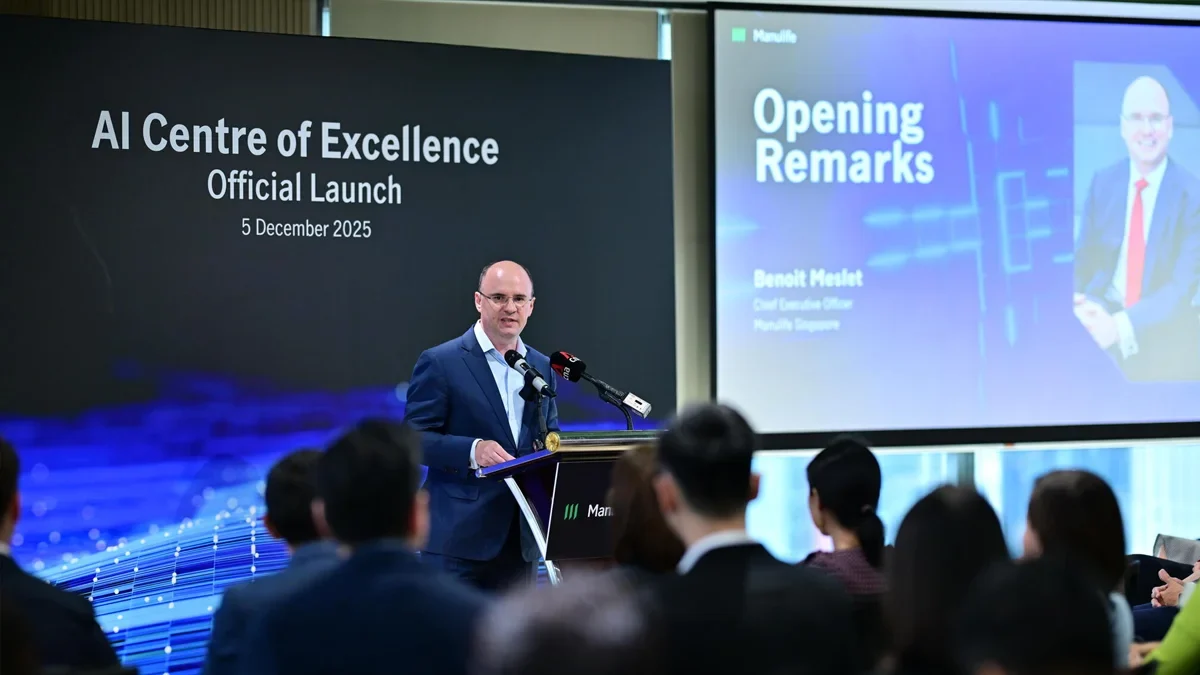
On December 5, Manulife launched a new AI Centre of Excellence in Singapore, which aims to enhance customer experiences and provide employees and advisors with tools and use cases across underwriting, operations, customer engagement, and distribution.
The push at the company highlights the growing urgency to adopt AI across the industry and, more broadly, Singapore’s welcoming stance towards the technology.
The insurer plans to work with the city’s research institutions and industry associations to grow AI talent and uplift the broader financial services sector. It also aims to work with colleges and universities to expose students to real-world AI applications in financial services and with the Singapore Institute of Banking and Finance (IBF) to upskill and reskill employees.
“Through the Centre of Excellence (CoE), Manulife is deepening collaboration with partners across Singapore’s innovation ecosystem,” Mark Czajkowski, Chief AI Officer at Manulife Asia told (Re)in Asia.
The CoE will serve as a testing ground for next-generation solutions, where they can be developed, refined locally and scaled across global markets, Czajkowski said.
“The financial services sector continues to face emerging challenges that will require new capabilities,” he added. “Over the next three years, the CoE will focus on addressing these gaps by piloting new solutions, refining model oversight practices, and embedding guardrails that can be applied across markets.”
Growing internal demand for AI upskilling
The insurer also launched a career conversion programme administered by IBF to redesign the role of retail underwriters, helping them leverage AI tools and enhance risk analysis and decision-making.
“Some of the programmes that the IBF has on offer… (are) really good to help our teams to harness these new skills and really accelerate their attractiveness in the marketplace and also develop and generate value for our customers,” Czajkowski said during the launch event.
Internal demand for AI upskilling and reskilling courses has been high, Czajkowski said, adding that there’s “a huge talent pool in Singapore that we’ll be able to tap into to help us rapidly accelerate and drive scale.”
By providing structured upskilling, Manulife aims to strengthen professionals’ skills, confidence and ability to work alongside AI, Czajkowski told (Re)in Asia. “Our goal is to help build a stronger, more future-ready workforce across the entire insurance sector.”
Central to these efforts is its proprietary ChatMFC platform that can streamline work in a number of areas, from personalising sales emails to summarising and comparing products or translating documentation.
Scaling ‘traditional’ AI capabilities and responsible use
Manulife has also established a combined data lake of call center interactions, live chats and customer relationship management data to predict and identify key trends, Czajkowski said.
“This can help us identify potential pain points, or certain situations which are causing anxiety to customers, so we can get actions to remediate and improve customer experience.”
The company has over 200,000 AI prompts generated in its Singapore office alone, while ChatMFC platform supports the company’s workforce across the value chain.
“We’ve been laying strong foundations, scaling traditional AI capabilities, stepping into this new world confidently, with generative AI and agentic AI,” he said. The insurer is committing to deploying AI responsibly, developing AI guardrails and improving its responsible AI framework, and will contribute best practices and insights to advance AI adoption as part of the Monetary Authority of Singapore (MAS) Pathfinder Programme (PathFin.ai).
All its models undergo rigorous testing before deployment, and human oversight is still central in interpreting insights and making final decisions, Czajkowski told (Re)in Asia. “We set strict accuracy standards to support underwriters’ work,” he said.
Ultimately, Manulife is betting that AI will make it possible to deliver faster, better and personalised service to customers, said Manulife Singapore CEO Benoit Meslet. “When our teams are supported by the right tools, they can spend more time on the moments that truly matter.”
Czajkowski said he hoped that Manulife’s efforts inspire broader industry momentum. “A well-equipped workforce enables insurers, not just Manulife, to pair technological efficiency with the human judgement and empathy customers value,” he said.
Manulife’s CoE is the latest in a series of efforts by insurers to leverage AI. FWD Group launched an AI lab in Singapore in October. Prudential Singapore opened its Global AI Lab in November 2024.
Singapore has welcomed AI with open arms.
Goh Hanyan, senior parliamentary secretary for Singapore’s culture ministry and environment ministry, said that the city is expecting to be a key player in developing AI trust.
“When companies within Singapore are collectively developing and deploying AI responsibly and validating their systems against rigorous standards, this builds trust in products and services developed in Singapore,” Goh said. “We think Singapore can be a key player in this area, where products and services carry a ‘Singapore trust mark’ as a signal of reliability, safety, and quality.”
Officials want to see more companies do more with AI, Goh said.
“These efforts are great examples of what we hope to see throughout the economy, where AI augments our work so that we can focus on things that require human-centric skills, building up relationships, exercising judgement, and thinking critically.”