











(Re)in Summary
• The US DFC has named Chubb as lead underwriter for a US$20bn maritime reinsurance facility to restore shipping through the Strait of Hormuz amid the conflict in the Middle East.
• The facility covers hull, cargo, war-risk, and environmental clean-up.
• Chubb and the DFC are seeking further US (re)insurance partners to expand capacity, with announcements expected soon.
• Analysts note that operational risks are likely to still deter shipping despite insurance.
• These concerns were brought to light when three vessels, including Thai and Japanese-flagged ships, were attacked near the Strait of Hormuz.
• Announcements, so far, have focused on American insurers, with the role of non-US (re)insurers not yet clear.
Chubb will lead the International Development Finance Corporation’s (DFC) US$20bn Gulf maritime reinsurance facility, the US government confirmed on Wednesday, but fresh strikes on merchant vessels yesterday have cast serious doubt on whether cover alone can restore shipping flows through the Strait of Hormuz.
The DFC on 6 March officially announced the launch of the reinsurance facility, which will cover losses of up to US$20bn on a rolling basis and initially focus on hull and machinery and cargo cover. Coverage will also extend to environmental clean-up costs.
Chubb will act as the lead underwriter, issuing policies for eligible vessels. The DFC and Chubb have jointly identified several American insurers to provide reinsurance behind Chubb and alongside the DFC to expand market capacity.
Chubb’s appointment is the first operational step towards the insurance solution that US President Donald Trump pledged on his Truth Social platform on 3 March, when he promised political risk cover for Gulf shipping at a “very reasonable price.”
Further reinsurance partners are expected to be named in the coming days.
Capacity gaps
Chubb’s appointment, plus the looming addition of those reinsurers, goes some way towards addressing concerns around capacity and the potential of withdrawal of the private insurers, as previously reported by (Re)in Asia.
Research from JPMorgan estimated that insuring 329 oil tankers operating in the region could require as much as US$352bn in coverage, including pollution liability, salvage costs, hull damage, and third-party liabilities. The DFC’s own statutory liability cap stands at US$205bn through 2031, of which US$51.5bn has been used by the end of 2025.
“With today’s announcement, we are one step closer to restoring market confidence and resuming energy and commercial trade disrupted by the conflict with Iran,” said DFC chief executive Ben Black.
“The commerce passing through the Strait of Hormuz plays a vital role in the global economy, and providing vessels with insurance protection is essential for resuming trade flows,” added Chubb chairman and chief executive Evan Greenberg.
Industry players, including Lloyd’s and Marsh, had also previously said they had commenced discussions with the DFC over an insurance solution in the region ahead of the formal announcement.
But a key question remains: what role global, non-American (re)insurers might play.
The DFC has been selective in the language it has used, in its media releases stating that it “has identified best-in-class, preferred American insurance partners” and that it will support “American” and “allied” businesses during the conflict, apart from asserting earlier its joint effort with Chubb on having identified several firms.
Capacity, however, is not the only constraint.
Thai, Japanese-flagged vessels struck
The Strait of Hormuz is the sole maritime route linking the Persian Gulf to the Arabian Sea, and roughly a fifth of the world’s oil passes through it.
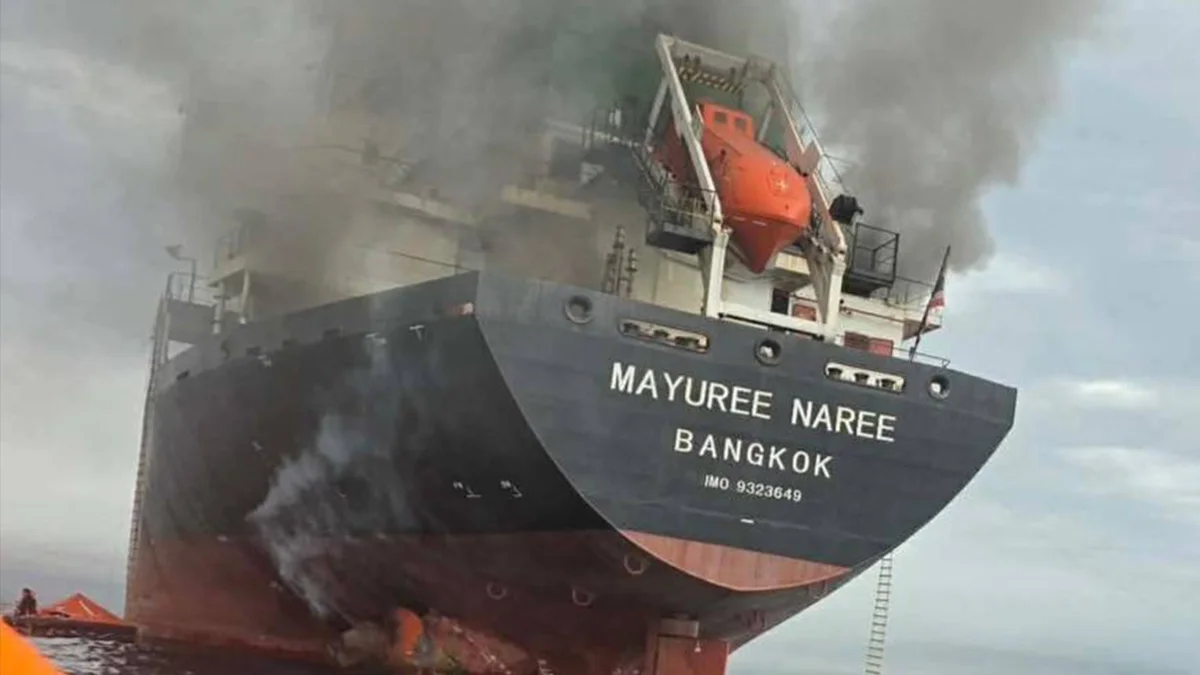
The scale of the risk in the region came into sharp focus on 11 March, the same day Chubb’s appointment was announced, when three commercial vessels were struck by unknown projectiles near the Strait of Hormuz, ending a 72-day lull in attacks on merchant shipping.
Among the vessels hit was the Mayuree Naree (IMO: 9323649), a Thai-registered bulk carrier owned by Bangkok-based Precious Shipping, which caught fire approximately 11 nautical miles off the Omani coast after departing Khalifa port in the United Arab Emirates. The Royal Thai Navy said the Omani navy rescued 20 of the 23 crew, with three remaining on board to assist recovery operations.
A Japanese-registered vessel, the ONE Majesty (IMO: 9424912), operated by Mitsui OSK Lines, was also struck northwest of Ras Al Khaimah, sustaining a 10-centimetre hole, though its crew were reported safe.
Morningstar DBRS warned in a 5 March report that elevated operational risks to vessels and seafarers — including missile strikes and drone attacks — may keep many operators reluctant to transit the strait, even if coverage is available.
The agency also noted that naval escort capacity could limit the pace at which vessels can move through the corridor.
Between 1 March and 9 March, at least 40 vessel transits within the Strait of Hormuz have been recorded, against a normal monthly rate of around 3,000, according to the Lloyd’s Market Association (LMA). Roughly 1,000 non-sanctioned vessels larger than 1,000 gross tonnes, with an aggregate hull value exceeding US$25bn, remain in the Persian and Arabian Gulf region, the LMA also says.
A Gulf of uncertainty
But perhaps the biggest question mark of all is the extent and the duration the reinsurance facility might be necessary.
Trump said earlier this week that he expects the conflict to “end very soon”, a development that would reduce the pressure on both the DFC facility and private markets.
By the same evening, however, the US president appeared to have softened on his previous rhetoric.
“We could call it a tremendous success right now. Or we could go further. And we’re going to go further,” he said.
Despite the current disruption and uncertainty, private war risk cover remains available.
Stephen Rudman, head of marine, Asia, at Aon, said earlier this month that war capacity is still accessible, even as insurers move to reprice war risk exposures following US-Israeli strikes on Iran.
There is no doubt about the importance of the shipping corridor. How long the conflict lasts — and how central the facility proves to be — remains to be seen.