



NRMA Insurance has committed A$500,000 (US$332,165) to eight Australian climate-adaptation ventures in the second round of its Help Fund Climate-Smart Innovation Grants, with the 2026 line-up skewing towards exposure mapping, environmental monitoring and land-management approaches that address loss drivers before they reach the claims ledger.
Announced on 23 November, the programme now runs two tiers: four Growth Grants of A$100,000 for solutions ready to deploy at scale, and four Emerging Founder Grants of A$25,000 for early-stage teams.
Among the Growth recipients, Geoneon fuses satellite data and AI to show councils, emergency services and infrastructure operators where assets are exposed to natural hazards. This is the kind of granular peril intelligence underwriters increasingly seek. BunjilView, a First Nations business, pairs traditional ecological knowledge with environmental sensors to extend cultural land management and reduce bushfire risk. Albon Capture targets climate-driven algal blooms through modular wastewater treatment for agri-food processors, while Totex Energy’s integrated home energy unit provides backup power during outages and extreme weather.
The Emerging Founder stream backs Blue Green Australia’s “floating foreshores” to blunt wave energy on urban shorelines, Divestream’s low-cost sensor-buoy networks for nearshore water quality, and two Indigenous organisations – Karrkad-Kanjdji Trust and Muru Mittigar – delivering wetland restoration, drought resilience and cultural burning.
Jennifer Cobley, NRMA Insurance’s executive manager for community impact and customer advocate, said widening the programme to both established and emerging founders should speed solutions with lasting community impact.
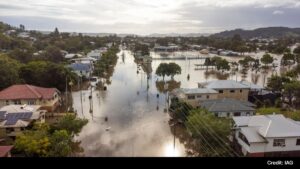
The grants land as the cost of recovery dominates the public debate. The Australian government has abandoned a plan to cut its share of disaster recovery funding to 50%, retaining Commonwealth contributions of up to 75% of eligible costs after pushback from Queensland councils. The retreat comes with insured catastrophe losses of A$4.8bn (US$3.2bn) in 2025, more than A$4.1bn of it in Queensland.