


(Re)in Summary
- AI adoption and rapid data-centre expansion are creating risk exposures faster than reinsurers can develop the capability to assess and price them.
- The industry can assemble only around US$15bn of capacity per risk against roughly US$70bn in excess industry capital.
- AI is increasingly embedded across insurance products, making exposure difficult to isolate and price accurately.
- (Re)insurers’ instinct to exclude new risks before building capability costs trust with cedants and customers who have no choice but to continue operating.
- Protectionism and data localisation threaten reinsurance’s cross-border risk-pooling model, posing the industry’s biggest structural risk.
AI adoption and data-centre expansion are creating exposures faster than reinsurers can develop the expertise to price them, SCOR group CEO Thierry Léger warned, arguing that capital cannot safely follow where underwriting capability has yet to emerge.
Speaking on the first day of the Singapore International Reinsurance Conference on Monday 2 November 2026, Léger pointed out the potential “capability gap” between the valuations of hyperscaler data centre projects and what the industry has capacity to insure as an emerging challenge.
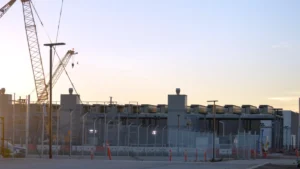
Hyperscale campuses now dwarf traditional data centres, with sites representing total insurable values of up to US$30bn for construction alone according to an S&P report in April. A Howden report published in October estimated that single hyperscale AI campuses can now carry insurable values of up to US$50bn, more than any one insurer can absorb.
The industry can currently assemble only around US$15bn of capacity per risk, against roughly US$70bn in excess industry capital, Léger said during his keynote session and fireside chat. “That’s a clear example of where capability has not yet been built, and with it, not yet enough capacity to actually fulfil the requirements of an emerging industry.”
Referencing Anthropic CEO Dario Amodei’s warning in the company’s IPO filing that “no single insurer, and potentially, the insurance industry in the aggregate, may have sufficient capacity or expertise to underwrite insurance” related to a catastrophic AI-related incident, Léger urged insurers to adapt, build trust and the capability needed to attract the capacity required.
“That [warning] just really shows the degree of challenge we are facing,” Léger said.
Build capabilities now
As AI gets embedded in most products the industry sells, exposure is starting to become difficult to isolate and price, Léger said.
“It’s an immense opportunity, similar to cyber, for our industry,” he said. “But we will have to invest in capabilities to allocate the necessary capacity to this very fast emerging exposure.”
But the industry instinct to exclude new risks and build capabilities later will mean that (re)insurers will lose trust from customers, Léger warned. “We would love to have 50 years of experience when we enter a new risk,” he said. “We don’t, so it’s a massive challenge for our industry.”
With the rapid adoption of AI, insurers will have to accept that as part of their business, said Léger. “We have to lean into these things and be real partners.”
Ungoverned agentic AI is a potentially emerging exposure, Léger warned, as companies increasingly embrace agentic hybrid virtual teams. The inability to audit AI decision-making, coupled with the ability for AI to hallucinate, has meant that agents will have to be registered and controlled like employees, he added.
“[There’s] a lot of impact on workforce and internal governance, and I think we have to be very clear so that we can actually profit from these new capabilities.”
Ageing, warming, fragmenting
Climate change, ageing societies, and geopolitical fragmentation have meant greater challenges — and opportunities — for the (re)insurance industry, Léger said.
Insurers are only beginning to scratch the surface of the risk landscape when it comes to ageing societies, Léger said. “We are only at the beginning of getting to insure and close the protection gap there,” he added. “There’s a massive demand out there.”
Climate change is also expected to bring capacity problems for (re)insurers, even with a soft market, Léger said. Insurers have covered only 8% of catastrophic losses in Asia, despite the existence of abundant capital.
There are very significant protection gaps that we have not been able to close, he said.
The geopolitical fragmentation witnessed over the last 10 years has also meant that the world is now more reliant on (re)insurance for resilience in supply chains and trade disruptions, said Léger.
“Even if today, we can see barriers increasing, the world is actually very connected,” Léger added. “We are all super dependent on supply chains, so anything we can do as an industry to support the stability of supply chains will be important.”
Rising political unrest and conflict have also created emerging risks that (re)insurers now have to properly price. It’s also meant that capacity is moving into political risk and trade credit.
“We can now see the impact of modern wars on certain lines of business, in a way that we have never seen before,” Léger said.
But protectionism from geopolitical fragmentation is expected to become a big structural risk for the reinsurance industry, Léger warned. As countries increasingly mandate that capital, assets and data stay onshore, they undercut the model reinsurers rely on, pooling risk across borders into a single balance sheet.
“As a global venture, SCOR is witnessing how barriers are being built, country by country,” he added. “[But] more and more countries want to keep all of this [capital] and are not enabling me to bring it to one balance sheet where I can enable that diversification, and so on a macro level, I see that as the biggest risk.”
(Re)insurance capital should only follow capability, and not the other way around, Léger stressed.
Léger said (re)insurers should maximise the capital moving into the industry, so it can be put to work in economic terms that actually work in the long term.
“If capacity is not following capability, we call it in our industry naive capacity, and we all know where naive capacity is leading,” he said.